Best Dermatology EHR Software in 2026: How to Choose the Right One
Choosing the right EHR (Electronic Health Record) system can make or break the efficiency, compliance, and profitability of your dermatology practice. This guide breaks down exactly what to look for, the pitfalls that trip up most practices, and how the leading platforms actually compare — based on verified user reviews, not marketing copy.What to Look For in a Dermatology EHR
Most EHR platforms were built for primary care and adapted for specialties later. That distinction matters more than any single feature on a sales sheet. Here's what to evaluate before you sign anything:- ✅ Dermatology-specific workflow, not a bolted-on module. A real dermatology EHR supports the full visit — excision, pathology, billing, follow-up — as one continuous, structured record.
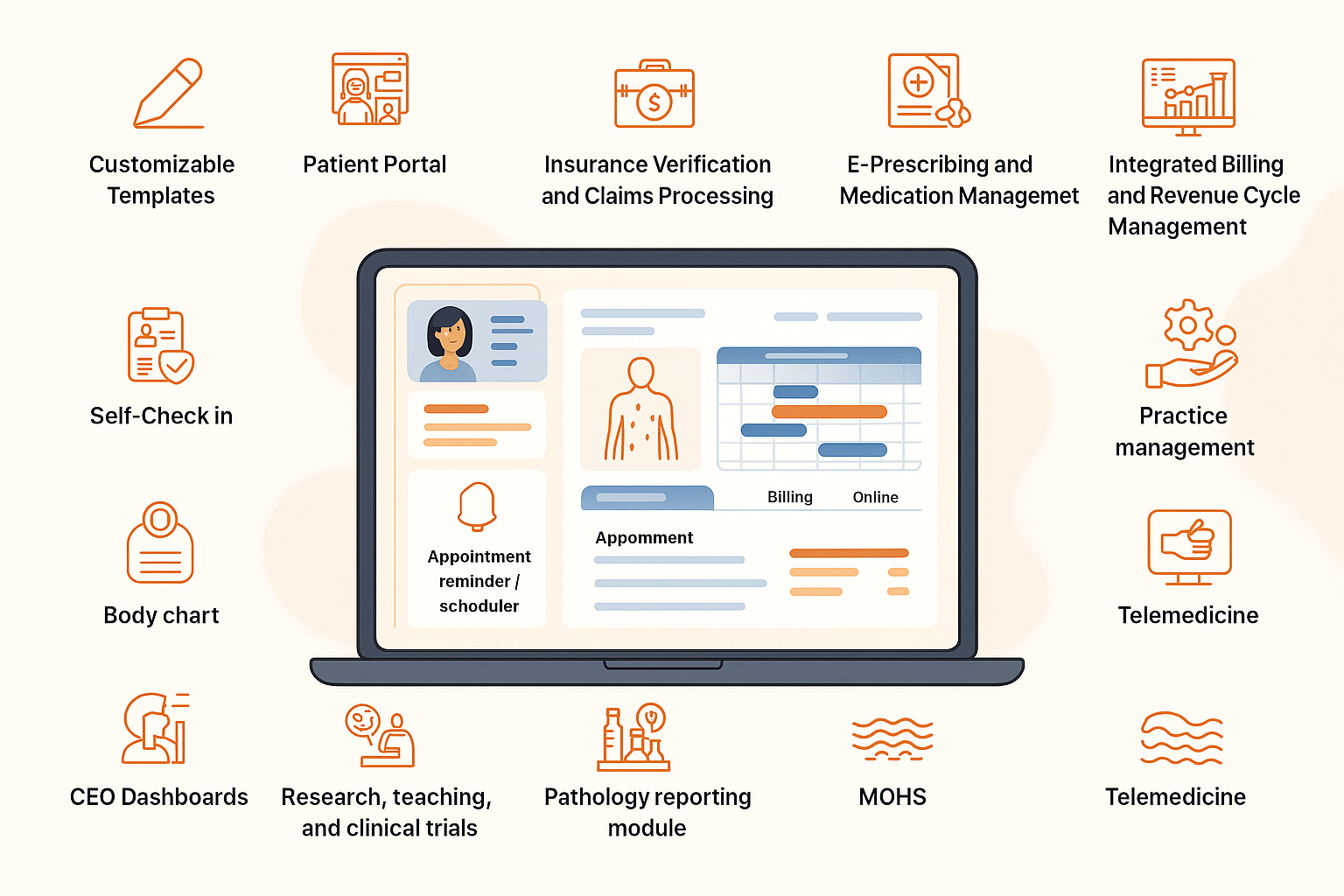
- ✅ Digital body and tissue mapping. Hand-drawn charts scanned in as static images create no structured data. Look for interactive, digital mapping linked to the patient record.
- ✅ AI documentation that's live, not "coming soon." Ask vendors directly whether AI charting is shipping today or still on the roadmap.
- ✅ Pricing transparency. Enterprise vendors often quote a base rate, then bill implementation, training, and "advanced modules" separately — turning a $300/month quote into $700+/month.
- ✅ Support that knows your practice. At scale, support becomes a ticket queue. Independent practices need a named contact who already understands their workflow.
- ✅ Data portability. Ask before you sign: what format will your data be in if you ever switch platforms?
Common Pitfalls of Generic EHR Systems
Across dozens of verified reviews on Capterra, Software Advice, G2, and KLAS, the same problems surface again and again when dermatology practices use general-purpose or multi-specialty EHR platforms:- Feature removal after updates — multiple verified users report a platform removing a feature they relied on daily, then charging to have it reinstated.
- Excessive clicks for routine tasks — one verified review cited 11 clicks just to refill a single medication.
- Support that doesn't resolve issues — a recurring complaint across platforms: staff spend hours on hold or waiting on email threads that go nowhere.
- Data held hostage on exit — practices switching platforms have reported receiving records in inaccessible formats, forcing them to rebuild from scratch.
- Hidden total cost of ownership — the quoted monthly rate is rarely the real cost once implementation, training, and add-ons are factored in.
Dermatology EHR Comparison: Legend EHR vs. the Major Players
Legend EHR was built specifically for dermatologists — not retrofitted for them. Here's how it stacks up against three of the most-searched alternatives, based on verified user reviews and published vendor information.| Feature | Legend EHR | Nextech | ModMed EMA | eClinicalWorks |
|---|---|---|---|---|
| Dermatology-only focus | ✅ Derm-only | Multi-specialty | Multi-specialty | General/primary care |
| AI ambient documentation | ✅ Live in production | AI charting (eyecare focus) | ✅ ModMed Scribe (750M+ encounters) | Eva AI + Sunoh integration |
| Mohs surgery workflow | ✅ Dedicated module | Not confirmed | Not confirmed | Not confirmed |
| Digital body/tissue mapping | ✅ Fully integrated | ✅ 3D smart stamping | Available | 3D hot-spot model (limited derm focus) |
| Pricing transparency | ✅ Clear, all-inclusive | Opaque, negotiated | Complex, $600–900+/provider/mo est. | $449–599+/provider/mo, plus add-ons |
| Support responsiveness | ✅ Same-day, named contact | Inconsistent, delays reported | Weeks-long waits reported | Below average across KLAS/Capterra/G2 |
| Data portability on exit | ✅ Full access guaranteed | Not confirmed | Not confirmed | Inaccessible formats reported |
Sources: verified user reviews on Capterra, Software Advice, G2, and KLAS. Full breakdowns available in our Legend EHR vs. Nextech, Legend EHR vs. Modernizing Medicine (EMA), and Legend EHR vs. eClinicalWorks comparisons.
“It's like it was built by dermatologists, for dermatologists.” — Dr. A. Patel, SkinRegen Clinic
“Very expensive — you are charged for everything. When there is an update they take away features... One feature we used regularly was taken away and we had to pay to get it back.” — Verified User, Software Advice (on Nextech)
Real-World Use Case
A mid-sized dermatology clinic in Florida reduced its charting time by 30% and improved billing accuracy by 22% within the first 60 days of switching to Legend EHR. They also launched their teledermatology offering in under 48 hours — using only built-in features from Legend EHR, no third-party tools required.Demo Checklist: Bring This to Every Vendor Demo
Don't leave a demo without direct answers to these questions:- What is the all-in total monthly cost for my practice size — including implementation, training, support, and every module I'd actually use?
- Is a Mohs surgery workflow module included, or "not confirmed" / not built for derm?
- Is AI documentation live in production today, or still on the roadmap?
- Who is my named support contact, and what's the typical first-response time?
- What format will my patient data be in if I ever decide to leave?
- Can I speak directly to a current dermatology client using this platform?
- What happens to features I rely on when the platform pushes an update?
Frequently Asked Questions
What is the best EHR for a dermatology practice?
The right answer depends on your practice size and priorities. Independent and boutique practices generally benefit most from a dermatology-only platform with transparent pricing and direct support. Large multi-location, multi-specialty groups with dedicated IT staff may be better served by an enterprise platform like Nextech or ModMed.
How much does a dermatology EHR cost?
Published rates typically range from $300–$900+ per provider per month depending on the vendor, but the quoted rate rarely reflects total cost of ownership. Implementation, training, data migration, and "advanced module" fees are frequently billed separately.
Do I need a dermatology-specific EHR, or can a general EHR work?
General EHRs can technically function for a dermatology practice, but verified reviews consistently show the same gaps: no dedicated Mohs workflow, body mapping that's an afterthought, and support teams unfamiliar with dermatology-specific billing needs.
What should I look for in a Mohs surgery EHR module?
A genuine Mohs module tracks every stage — excision, tissue orientation, pathology, and repair — as one continuous structured record, and auto-generates CPT codes from that record.